



Annual Personal Income Tax Return under Art. 50 of the Bulgarian Personal Income Tax Act – Electronic or Paper Submission?
Filing the annual personal income tax return under Art. 50 of the Bulgarian Personal Income Tax Act is an obligation for many individuals and raises an important question each year – is it better to submit the declaration electronically or on paper. Both options are legally acceptable, but they differ significantly in terms of completion, risk of errors, and overall convenience.
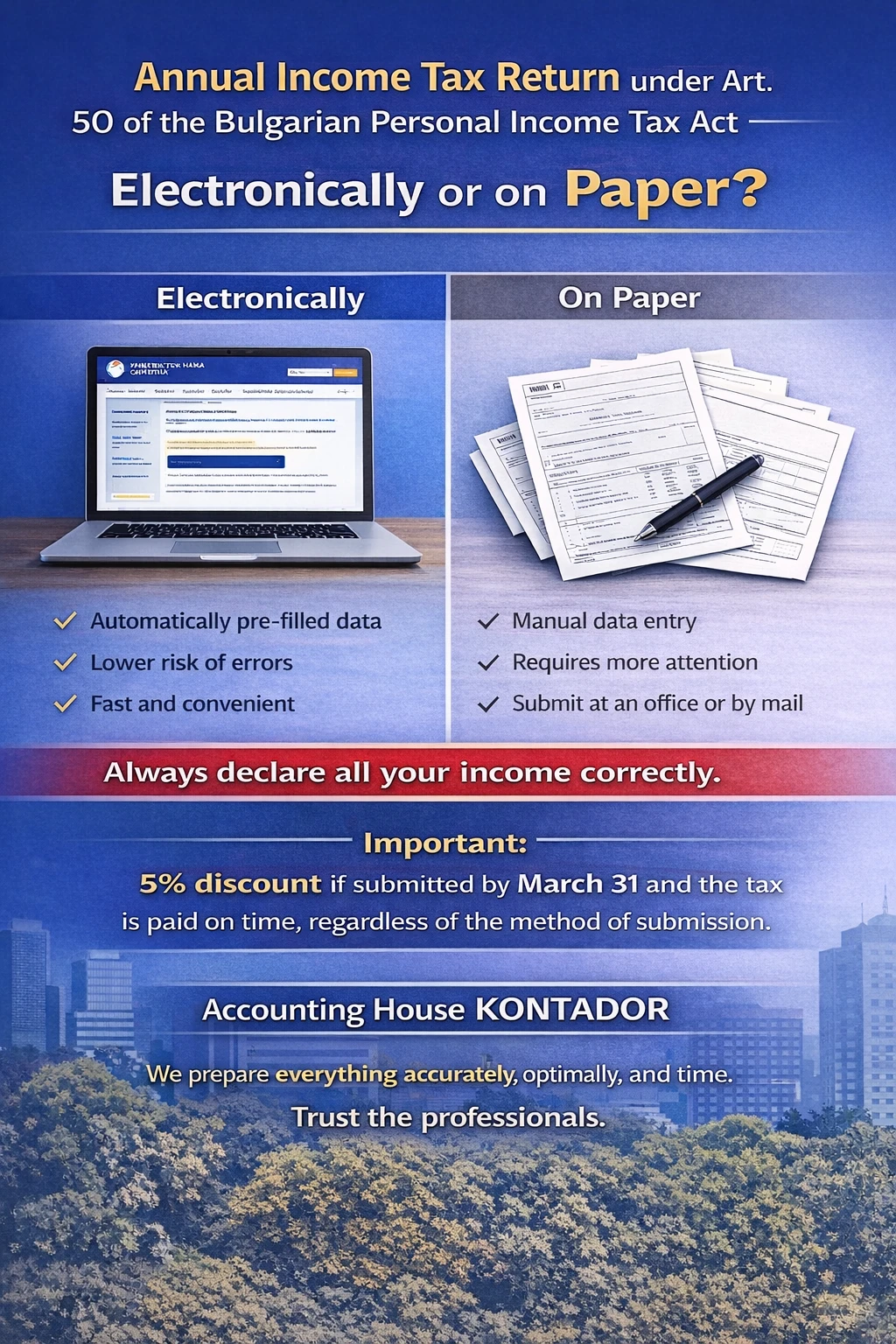
When submitting electronically, the tax return is completed through the portal of the National Revenue Agency (NRA) using a Personal Identification Code (PIC) or a qualified electronic signature. In this case, part of the data is pre-filled automatically – for example income from employment, civil contracts, rent, or other sources reported by employers and payers. The system performs checks and supports calculations, which significantly reduces the likelihood of technical errors. This makes the electronic option faster, more secure, and more convenient for most individuals. An additional advantage is the possibility to benefit from a 5% discount on the tax due, if the return is submitted and the tax is paid by March 31.
Submitting the declaration on paper remains an alternative for individuals who do not have a PIC or electronic signature, or who prefer personal service. In this case, the declaration is submitted at an NRA office or sent by post with a return receipt. Unlike electronic submission, all data must be completed manually. There is no automatic data population, no real-time validation, and no automatic calculations. This means that the risk of errors is higher, especially in more complex cases involving different types of income. In addition, the 5% discount is not applicable when filing on paper.
Regardless of the chosen method, one key principle always applies – the responsibility for the accuracy of the declared data lies entirely with the individual submitting the return. Even when filing electronically, the pre-filled data must be carefully reviewed. In practice, there are often cases where income from abroad, from other individuals, or from additional activities is missing because it has not been reported to the NRA. When filing on paper, this risk is even higher, as all data is entered manually.
The most common mistakes include omitted income, incorrect selection of annexes, duplication of income when having more than one employer, and failure to apply available tax reliefs. In paper submissions, these are often combined with calculation errors and technical omissions such as missing signatures or incomplete personal data.
The deadline for submitting the annual tax return is April 30, with the possibility of one correction until September 30 of the same year. This allows for correction of mistakes, but does not replace the need for careful and accurate completion from the outset.
In conclusion, electronic filing is generally the more efficient, secure, and cost-effective option, while paper submission requires greater attention and preparation. Regardless of the method chosen, the key to a correctly submitted tax return lies in the proper identification and accurate reporting of all taxable income.
For additional services and professional assistance with the preparation and submission of the annual personal income tax return under Art. 50 of the Bulgarian Personal Income Tax Act, you can rely on the team of Accounting Firm KONTADOR. We will ensure that everything is prepared accurately, optimized, and submitted on time, helping you avoid errors and pay exactly what is due, without unnecessary risks.