



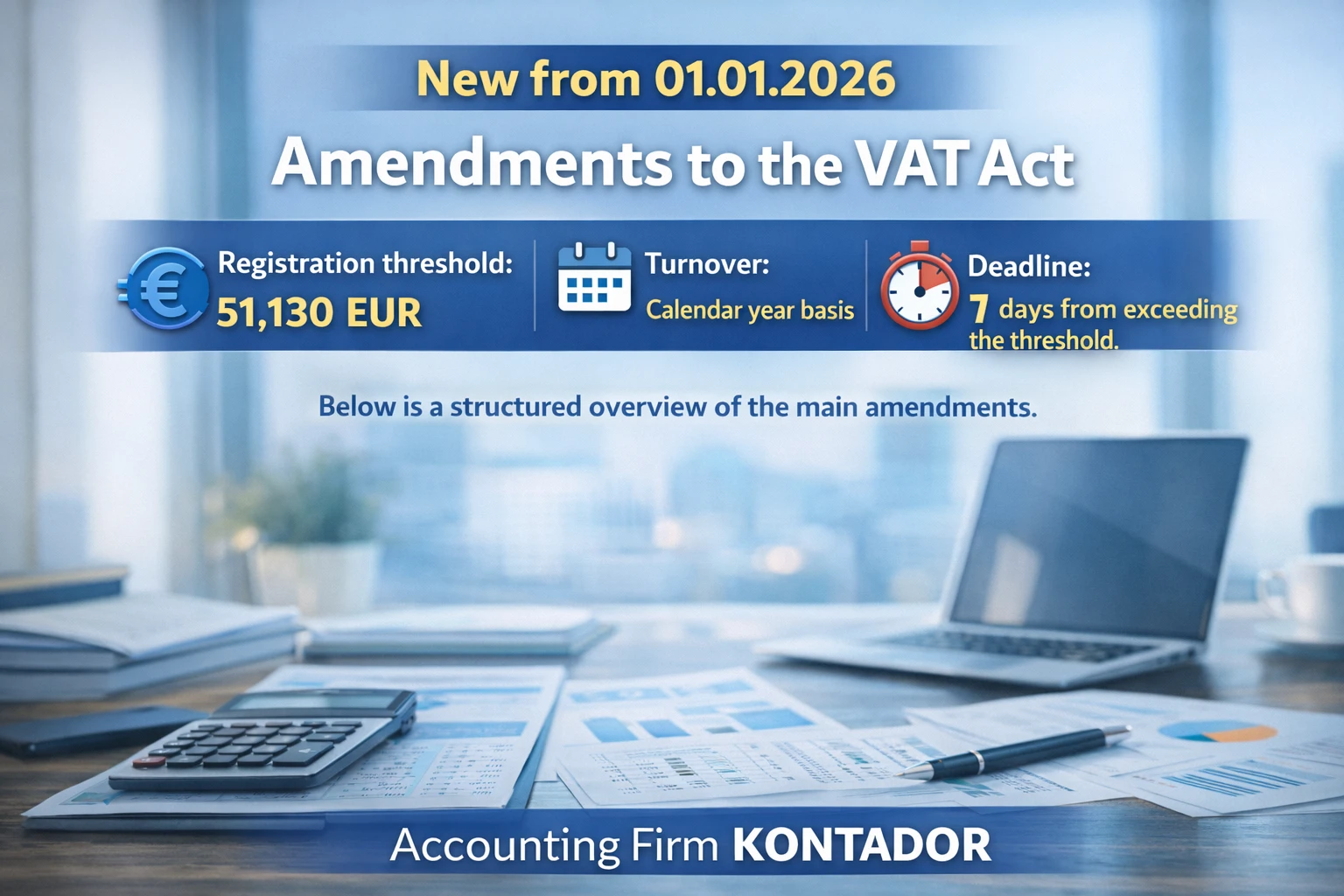
Amendments to the VAT Act as of 01.01.2026 – N
ew Regime for Small Enterprises
On 30 December 2025, the Act amending and supplementing the Bulgarian VAT Act was promulgated in the State Gazette, issue No. 115. The amendments entered into force on 1 January 2026.
Through these changes, Directive (EU) 2020/285 is transposed into Bulgarian legislation, introducing a new special regime for small enterprises (SME regime).
The amendments are substantial and affect almost all persons not registered for VAT, including:
- a new mandatory VAT registration threshold expressed in euro;
• a new method for determining annual turnover;
• introduction of two regimes for small enterprises;
• changes in the deadlines and the method of monitoring turnover.
Below is a structured overview of the main amendments.
- Registration threshold and annual turnover
1. New mandatory VAT registration threshold
As of 1 January 2026, three key changes apply with regard to mandatory VAT registration under Article 96 of the VAT Act.
1.1. Turnover is now monitored on a calendar-year basis
Until now, turnover was monitored based on the last 12 consecutive months (a rolling period).
As of 2026, this changes as follows:
- turnover is monitored for the calendar year from 1 January to 31 December;
• however, monitoring is performed on a daily basis rather than monthly.
In practice, this requires continuous tracking of revenues from the very beginning of the year.
1.2. The threshold is now set in euro – EUR 51,130
The previous threshold in Bulgarian leva is replaced by a threshold of EUR 51,130.
An extremely important aspect, highlighted by the National Revenue Agency in its latest guidance, concerns the method for determining turnover for the year 2025.
Although turnover is calculated for a past period, the new rules under Article 168v of the VAT Act must be applied.
This means that:
- supplies which under the previous regime were excluded from turnover (for example certain real estate transactions or financial services when they are not incidental);
• may now be included when determining whether the EUR 51,130 threshold has been exceeded.
It is therefore strongly recommended that the structure of revenues for 2025 be carefully reviewed in light of the new definition of “ancillary supplies”, in order to avoid missing an obligation for VAT registration.
1.3. New deadline for filing the VAT registration application – 7 days from exceeding the threshold
A significant change also applies to the registration deadline.
Previous regime: application submitted by the 7th day of the following month.
New regime: a 7-day deadline starting from the actual date on which the threshold is exceeded.
Example:
If the threshold is exceeded on 5 March, the VAT registration application must be submitted no later than 12 March.
This makes daily turnover monitoring mandatory.
- Invoicing between 01.01.2026 and receipt of the registration act
A practical question often arises regarding the documentation of sales performed in the period between 1 January and the receipt of the VAT registration act.
According to the guidance of the National Revenue Agency:
- all supplies carried out during this period;
• must be invoiced with VAT or previously issued documents must be corrected accordingly;
• within a 5-day period from the date of service of the VAT registration act.
This deadline is extremely important, as it:
- preserves the right to deduct input VAT for customers;
• prevents the imposition of penalties;
• ensures correct VAT reporting for the transitional period.
The amendments to the VAT Act as of 2026 require increased attention, timely turnover analysis and accurate assessment from the very beginning of the year in order to avoid omissions and sanctions.
For questions related to the application of the new VAT regimes, VAT registration or the need for professional consultation, you may contact Accounting Firm KONTADOR, where you will receive clear guidance, reliable support and an individual approach in line with the applicable legislation.